San Diego Timeline

SPANISH COLONIAL CENSUS

This census listed the men, women, boys, and girls of the Presidio de San Diego district. Separate listings were made for each of the missions and the Presidio itself; the numbers are also identified either as “Indian” or Spanish, and other castes.”
DON PÍO PICO SETTLES IN SAN DIEGO IN THE 1820S, BEFORE BECOMING THE GOVERNOR OF CALIFORNIA
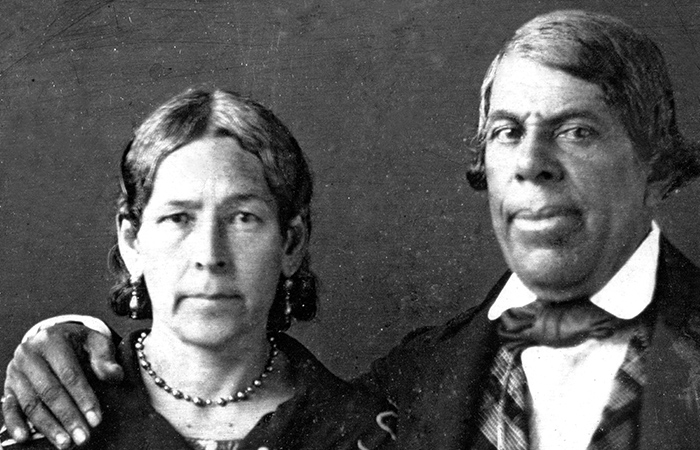
Pico’s governorship was California’s last under Mexican rule. His family is known to have Spanish, Indian, and African ancestry.
ALLEN LIGHT, AN AFRICAN AMERICAN MARINER, SETTLES IN SAN DIEGO AND BECOMES A NATURALIZED MEXICAN CITIZEN
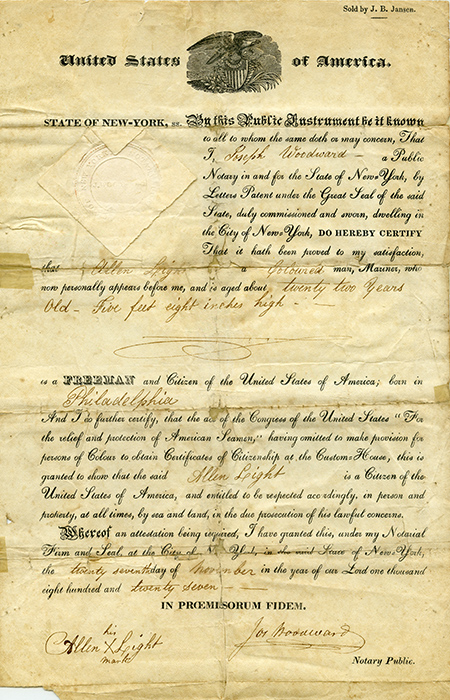
Mariner Allen Light carried sailor protection papers dating from 1827 to maintain his status as a “freeman and citizen of the United States of America.” These papers were discovered in the walls of the Machado Chapel in Old Town in 1948.
AMERICA NEWTON MIGRATES TO THE JULIAN AREA

America Newton was a formerly enslaved person who arrived from Missouri. In Julian, she made her living as a laundress for local miners.
THE HOTEL ROBINSON IN JULIAN WAS BUILT
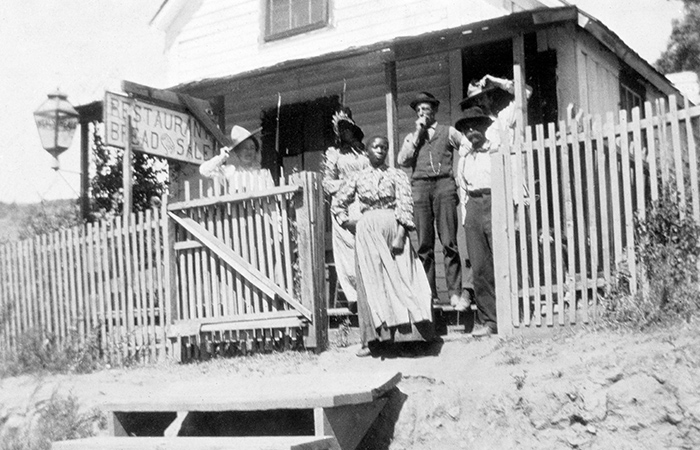
Albert Robinson, a formerly enslaved person from Missouri and his wife, Margaret, owned and operated the Hotel Robinson in Julian, from 1887 until Albert’s death in 1915. Margaret Robinson continued ownership until 1921.
Pictured above: Robinson Hotel c. 1910
BETHEL AFRICAN METHODIST EPISCOPAL (AME) CHURCH IS FOUNDED. IT BECOMES THE FIRST ORGANIZED BLACK RELIGIOUS INSTITUTION IN SAN DIEGO
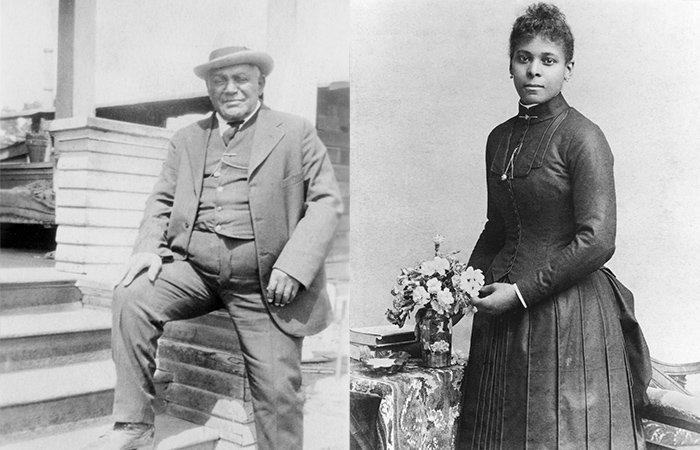
Solomon and Cordelia Johnson were instrumental in the formation of the first Black church in San Diego, the Bethel African Methodist Episcopal Church. The membership of the church met in the Johnson home on the corner of F and Union Streets until funds were raised to secure a church site.
Pictured Above: Solomon Johnson c. 1920, Cordelia Johnson c. 1887
BLACK PIONEER STUDIO PORTRAITS
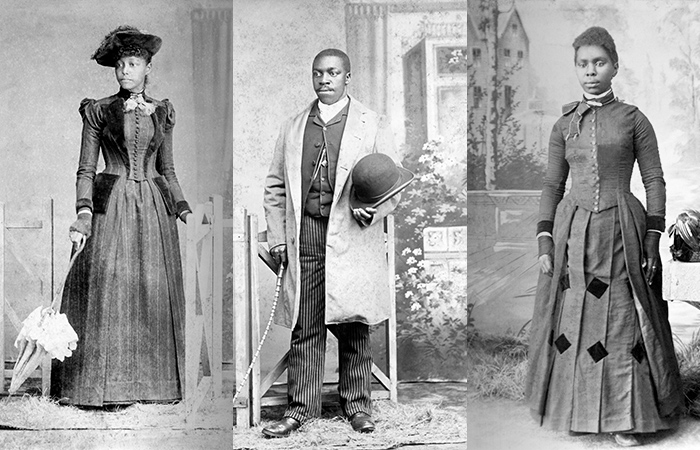
These images are likely the only known surviving historical record of these San Diegans and their time here. These studio portraits were taken between 1891and 1893 at Turner’s Elite Studio and Klimdt’s Chicago Art Gallery, both located on Fifth Avenue in downtown San Diego.
Pictured Above From Left to Right: Woman with parasol, nd, Man with derby hat, nd, Woman with dress, nd
EDWARD W. ANDERSON ESTABLISHES IXL LAUNDRY

Edward W. Anderson arrived in San Diego in the mid-1890s from Kentucky before beginning his successful laundry business in 1897 at age 25. As owner of IXL Laundry, he managed the largest steam laundry in the region with 35 employees. The original location was at 546 Seventh Avenue, but later the business moved to 10th Avenue and Island Avenue.
Pictured Above: IXL Laundry, 1897
ANDERSON V FISHER, 1897 IS THE FIRST RACIAL DISCRIMINATION CASE OF ITS KIND IN SOUTHERN CALIFORNIA

In 1897, Edward W. Anderson, a prominent entrepreneur and political organizer, and his wife, Mary, were refused seats for a performance at the Fisher Opera House. When they were denied their chosen seats near the orchestra, theater manager John C. Fisher explained, “I do not allow colored people on that floor.” Anderson filed a lawsuit for $299 in damages, and was awarded $150. The judgement was reversed by a higher court on Fisher’s appeal and Anderson was ordered to pay Fisher $9.25 in damages. Even though Anderson’s legal action was ultimately unsuccessful, his challenge set a legal precedent.
Pictured Above: Fisher Opera House, 1902
ACME SOCIAL CLUB IS STARTED
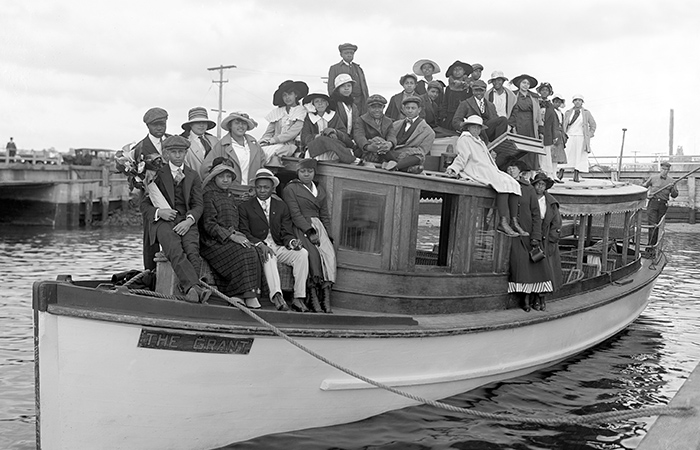
Acme was one of several elite social and political clubs in San Diego, established around the turn of the 20th century when Black San Diegans began to own more businesses and to make inroads into the economic mainstream.
Pictured Above: 17th birthday celebration of Acme member Gathern P. Perry, c. 1917
HENRIETTA GOODWIN IS THE FIRST AFRICAN AMERICAN GRAUDATE FROM THE STATE NORMAL SCHOOL OF SAN DIEGO, NOW SDSU

Henrietta (seated on right) was a graduate at the State Normal School of San Diego (now SDSU). The San Diego Union failed to mention her in its list of the 15 graduates, nor did the school list heron its roster of graduates. However, both an attendance ledger and her registration record card indicate that she did in fact graduate on January 30, 1913, having attended the school sporadically since 1908. Her younger sister, Lela (standing, second from right), preceded Henrietta as a registered student in 1907, but she dropped out after taking just four classes. The Goodwin sisters worked occasionally as domestic servants to support their studies.
Pictured Above: Goodwin family, c 1902
THE FIRST BLACK AMERICAN FIREFIGHTERS JOIN THE SAN DIEGO FIRE DEPARTMENT

Pictured Above: Sandy Baker, Tim Williams, John Cross, and Joe Smith, early Black Firefighters in Logan Heights, c. 1927
THE HOTEL DOUGLAS IS BUILT IN SAN DIEGO’S GASLAMP QUARTER

Located at Second Avenue and Market Street, the Douglas Hotel and Creole Palace nightclub was the only place of quality lodging and entertainment for Blacks during a period of intense segregation. As the premier Black entertainment venue on the Pacific coast, the spacious ballroom and stage featured a risqué chorus line show and jazz, blues, and boogie-woogie performances. The hotel-nightclub hosted celebrities like boxer Joe Louis, musicians Louis Armstrong and Duke Ellington, and vocalists Billie Holiday and Dinah Washington.
Pictured Above: Creole performers at the Douglas Hotel, 1934
THE SAN DIEGO RACE RELATIONS SOCIETY IS FOUNDED BY DENNIS V. ALLEN

The San Diego Race Relations Society sought to end prejudice against racial, national, and religious groups. This group was instrumental in pushing for desegregation in public spaces, as well as in challenging the denial of jobs because of religion, race, or color. Dennis Allen served as president of the Race Relations Society and helped expand employment opportunities for San Diego’s Black community.
Pictured Above: Dennis V. Allen, 1945
THE LEMON GROVE CASE IS THE US’S FIRST SUCCESSFUL SCHOOL DESEGREGATION CASE

The incident occurred in 1930 and 1931 in Lemon Grove in San Diego’s East County, where the local school board attempted to build a separate school for children of Mexican heritage. On March 30, 1931, the Superior Court of San Diego ruled that the local school board’s attempt to segregate 75 Mexican and Mexican American elementary school children was a violation of California state laws because ethnic Mexicans were considered white under the state’s Education Code.
Pictured Above: Segregated Students from Lemon Grove Grammar School
DR. JACK JOHNSON KIMBROUGH ARRIVES IN SAN DIEGO AND BECOMES THE FIRST BLACK DENTIST IN THE AREA
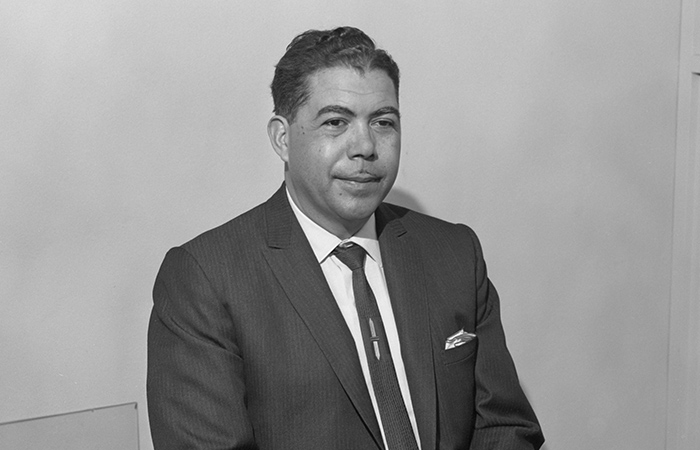
When Dr. Kimbrough heard of the absence of African American dentists in San Diego, he hitchhiked to the city in 1935 and befriended the only Black physician in the area, A. Antonio DaCosta, who lent him office space in a rental unit. Dr. Kimbrough went on to become president of the San Diego NAACP in 1947 and the first president of the San Diego Urban League in 1953. Kimbrough accomplished much as an activist, including organizing a sit-in at the US Grant Grill in 1948 to protest segregation, and working to end racial prejudice.
Pictured Above: Dr. Jack Kimbrough, 1960
HOWARD “SKIPPY” SMITH OPENS PACIFIC PARACHUTE COMPANY

Howard “Skippy” Smith was an African American stunt pilot and entrepreneur. Smith opened his Pacific Parachute Company, which sewed and packed parachutes for the military, and earned the title of “Top Black Owned Business in the United States” in 1943 from Time magazine. Smith employed one of the few integrated workforces in San Diego, which included Filipinos, Asians, whites, Latinos, and Blacks.
Pictured Above: Howard “Skippy” Smith and his integrated workforce, 1943
JOHNNY RITCHEY IS THE FIRST AFRICAN AMERICAN BASEBALL PLAYER TO JOIN THE SAN DIEGO PADRES

Ritchey became “the Jackie Robinson of the West Coast” by breaking the Pacific Coast League’s color barrier in 1948 while playing for the Padres. His debut came just one year after Jackie Robinson broke the major league color barrier with the Brooklyn Dodgers. Ritchey played for the Padres as a catcher in 1948 and 1949.
Pictured Above, From left: Luke Easter, Artie Wilson, and Johnny Ritchey integrated the minor-league San Diego Padres, 1950
SAN DIEGO URBAN LEAGUE IS ESTABLISHED

It was the perseverance of Dr. Jack Kimbrough, among others, that was crucial in finally establishing a local Urban League branch in 1953. In many cities the local NAACP branch fought for civil rights, but in San Diego it was the Urban League that played the pivotal role after World War II in pushing for civil rights and full inclusion in the city’s burgeoning economy. The San Diego Urban League had an ability to unify competing interests, and work on behalf of communities of color. Among its successful programs was a vocational education program introduced to city schools in 1956. Another success was the Adopt-A-Child program, a charitable project that represented a collaborative effort between several social service agencies.
Pictured Above: First Annual Meeting of the San Diego Urban League, 1955
WOOLWORTH DEPARTMENT STORE CHAIN SEGREGATION PROTEST
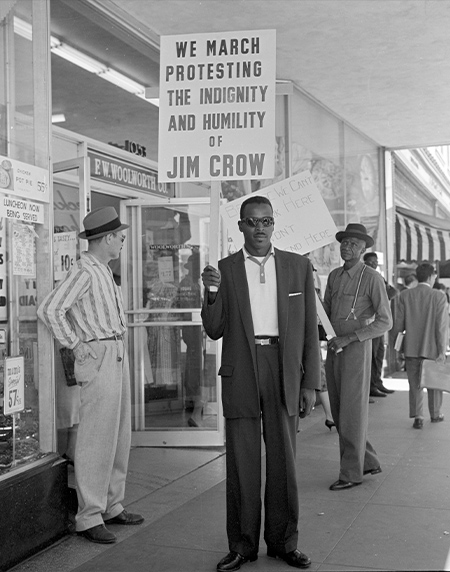
The Greensboro sin-ins were an act of nonviolent protest against a segregated lunch counter in Greensboro, North Carolina that began on February 1, 1960. The protests led the Woolworth Department Store chain to end its policy of racial segregation in its stores.
Pictured Above: A man protests in front of Woolworth’s storefront in downtown San Diego, 1960
RACIAL EQUALITY SIT-IN AT SDG&E

Members of the Congress of Racial Equality (CORE) stage a sit-in at SDG&E’s Sixth Avenue and E Street location to protest and change discriminatory hiring practices.
CORE PICKETS CREA
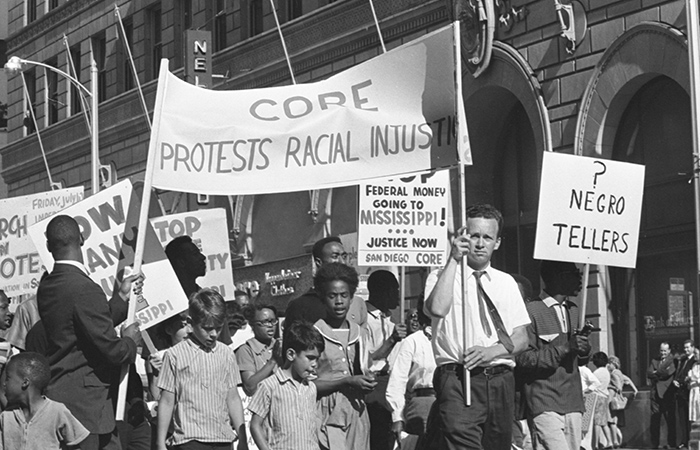
Congress of Racial Equality (CORE) members protested the California Real Estate Association’s meeting outside the El Cortez Hotel in Downtown. CREA was meeting to determine whether or not it would support Proposition 14, the law which would negate the Fair Housing Act.
MARTIN LUTHER KING JR GIVES A SPEECH AIN SAN DIEGO AT THE CALIFORNIA WESTERN UNIVERSITY

King was on a speaking tour of California cities, and addressed both California Western University (now Point Loma Nazarene University) and San Diego State College (now San Diego State University) on the same day. In his speech at Cal Western, King spoke out against California’s Proposition 14. This ballot measure, which would pass that November, in effect repealed the Rumford Fair Housing Act of 1963 and allowed individuals to practice discrimination when selling or renting property. King’s address gave national context to the issues of segregation and racism prevalent in San Diego and California.
Pictured Above: Martin Luther King Jr. addresses crowd at Cal Western University, May 29, 1964
STUDENT NON-VIOLENT COORDINATING COMMITTEE RALLY

San Diegans from the Student Non-Violent Coordinating Committee (SNCC) participated in a rally in Balboa Park after a 24-hour fast to memorialize James Reeb. Reeb was a white Unitarian Universalist minister and civil rights activists murdered by white segregationists in Selma, Alabama.
CARLIN V BOARD OF EDUCATION CASE

The San Diego Union School District (SDUSD) had received many complaints concerning the segregation of city schools since the early 1960s. Carlin et al v. Board of Education was a 1967 court case filed against SDUSD by a group of parents citing inequalities for students of all ethnic backgrounds.
Pictured Above: Ann Merrill speaks to the school board on behalf of a group that worked to desegregate San Diego schools, 1968
SAN DIEGO REACTS TO THE ASSASSINATION OF MARTIN LUTHER KING JR.

The day after Dr. King’s assassination, students from University of California, San Diego, rallied outside the City Council chambers. A memorial was held for Dr. King at the Balboa Bowl three days after his assassination. Over 5,000 people attended the service which was organized by the Southeast San Diego Ministerial Alliance. Religious leaders from Catholic, African American Methodist Episcopal, Jewish and other faith communities were present to honor King.
BLACK PANTHER PARTY FORMS IN SAN DIEGO

The Black Panthers were a Black power party formed in Oakland in 1966 and came to San Diego in 1968. They based their political philosophy and perspective on leftist and Marxist-oriented thinkers. Nationally, while the Panthers were known for brandishing firearms and confronting police in urban neighborhoods, the Party also had an ambitious social program. They started schools, supplied groceries to seniors, and operated a free breakfast program for children.
KU KLUX KLAN GROUPS RESURRECTED IN SAN DIEGO

From the 1920s on, San Diego had seen sporadic Ku Klux Klan activity. In San Diego and other southwestern cities, Klan activity was not just directed against African Americans, but toward Mexican Americans as well. Despite losing their charter in 1946, by the 1970s the Klan groups had seen a resurgence in San Diego and Oceanside.